We started this blog into order to allow Cardfight! Vanguard enthusiasts in Singapore a convenient way to look for specific cards that they want without going through the trouble of hunting for them one by one. We hope that by doing so, more people are able to enjoy Cardfight! Vanguard in Singapore fully! We also provide a variety of other services such as preordering upcoming products and organising tournaments.

Do contact us if you have any queries. Do check back from time to time as we may have special events or promotions.

Come down and join us if you can!! Details at the tournament page.

If you wish to order anything from us, just send us an email at sgvanguardonline@gmail.com with your request! Friends from overseas! If you wish to buy from us, do contact us as well!

Showing posts with label articles. Show all posts

Monday, 4 November 2013

Is Vanguard All about Luck?!

Is Cardfight Vanguard all about luck? Is luck the only deciding factor in a game of Cardfight! Vanguard?

Recently chanced upon an interesting article by Felix Suroso at alterrealitygames talking about Cardfight! Vanguard and how much of it is dependent on luck and how much of it on skill.

Have a read and enjoy!

Click here!


Tuesday, 29 January 2013

Trash Cards!?!

Lion heat! Ravenous Dragon, Gigarex! Cosmo Lord!! Again and again!! Arghh!!

Everytime you pull trash cards from your cardfight! vanguard booster pack, do you secret curse bushiroad for making such cards?

Do you wonder why such trash exist in Cardfight! vanguard?
Is Bushiroad evil and just trying to suck our money dry!?

Here are some articles that explains why are there bad cards in a trading card game, and yes, even why are there bad rare cards! (Although the articles are about another trading card game, Magic the Gathering, the general principles would apply to almost all trading card games:)

Enjoy!!


Maybe after reading these... you would not feel so bad pulling another Lion Heat... yet again... not!!


Wednesday, 22 August 2012

Deck Analytics Part 1

This is the first and hopefully one of the many deck analysis that I would put up. I am not at all a pro, so take my comments with a grain of salt and a large dose of your own opinion. If you have any views or opinions, please post them in the comment section! Thanks!


This is the Decklist that had won the Vanguard Fight Championship 2012 Seniors in Japan. I am Going to attempt to analyze the deck, so that we would be able to gain more insights into deck construction. Of course what I think may not actually be correct, if you have other perspective or noticed any errors, please comment below so that I can add in or make any changes. The purpose of this deck analysis is not to encourage netdecking, I still think that you should construct your deck according to your playstyle. However, by taking a look at other decks, we hope to gain insights which allow us to create our own personal decks better. :)

Now, general deck idea would seem to be a beatdown deck. With 12 criticals, the deck tries to create columns that hit the magic number to pressure your opponent. With the 12 critical triggers, your opponents will be forced into more pressure.

So let's Start with the Grade 3s.
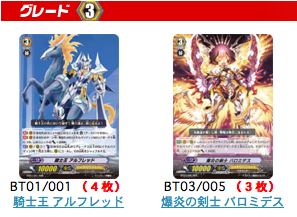
4 Alfreds and 3 Palomides. Palomides is straight forward beatdown. Together with the Marrons and Toypugals, you will have your 21k and 22k columns to force your opponents into a 15k guards if their vanguard is 10k/11k. Alfred with a full field will be 20k, meeting the min of a magic number, with 4 rearguards, 18k, meeting the magic number for crossrides. You are also able to use his counterblast to finish making your ideal field.

About the Grade 2s.
Now the first thing you may notice is the 5 10k vanilla. Now, currently the 10k vanillas may not be as useful in our english meta as the Japanese, as we do not have any crossrides yet. The 10k Vanillas, together with Marrons and Toypugals will meet 18k, the first magic numbers for crossrides. With the rampant running of DOTE in the Japanese meta, this is actually quite important. They can also be used to intercept, which frees the space for your palomides to come in. 4 Blaster blades, almost a card staple in a Royal Paladin deck, although not always at 4, allows you to retire any irritating rearguard that your opponent may call into the field(since using only 2 cb, will allow you to use your alfred's cb). Also, with Iseult, will hit 15k, with Liens, toypugals and Marrons will hit at least 16k. The 2 Akane will allow you to fetch out the toypugals which you may need to complete your columns, intercepting after that. However, with Lien will reach 15k and at least 16k with Toypugals and Marrons.

About the Grade 1s.
4 Iseults, Staples, almost every deck in the Japanese meta will contain 4 perfect guards to guard against crossrides and other big hitters. Marrons and Toypugals, will complete your 21k columns together with Palomides. They will also allow you to hit 16k with Blaster blade, Akane and 16k with the 10k Vanilla. The 3 Lien other than making 16k Columns will allow you to cycle cards you do not need, such as Alfreds when you have already ridden one. Since Alfred cannot be boosted, Lien will most probably go under your Vanguard so that you can still use its ability with Alfred as your vanguard since it can't be boosted. Making use of all the cards in your field.
About the Grade 0s.
12 Crit triggers, maximum pressure to your opponent. 4 Heal Triggers, Self explanatory, almost in every deck. Wingal Brave, with Barcgal being banned as Starting Vanguard, just the next better alternative since Drangal is only useful in a Galahad Deck, Bluegal in a High Beast Deck. Wingal Brave allows you to get another Blaster blade if it boosts a Blaster Blade, Since you have 4, it's quite likely.
Imagine! (Perfect field)
The perfect field will most likely be Alfred as your vanguard with Lien behind it. One or two columns of Palomides and Toypugals/Marrons to finish your opponent. Else one column is Blasterblade with the Grade 1 boosters to reach 16k.

Conclusion
This deck is fast, easy to complete your perfect field, straightforward and hits hard. With Alfred, Akane and Lien, they allow you to get the cards that you want to complete the perfect field for you to end the game. 12 Crits puts maximum pressure on your opponent. A lean and mean machine this deck is. As this deck do not have any Draw triggers, you may not be able to gain as much card advantage, however, Alfred, Akane and even Blasterblade would be able to help you with that problem.

You should also mention that Wingal Brave can boost Palomides to hit the magic 18K when facing crossride units.
- ShiningPaladin


Full Decklist

Grade 3
4 King of Knights, Alfred
3 Swordsman of Exploding Flames, Palomides

Grade 2
4 Blaster Blade
3 Knight of Silence, Gallatin
2 High Dog Breeder, Akane
2 Knight of Determination, Lamorak

Grade 1
4 Flash Shield, Iseult
4 Little Sage Marron
3 Lake Maiden, Lien
4 Toypugal

Grade 0
1 Wingal Brave
4 Bringer of Good Luck, Epona
4 Alabaster Owls
4 Yggdrasil Maiden, Elaine
4 Future Knight, Llew

Tuesday, 14 August 2012

Deck Box Part 1

First in a series talking about the decks that I have. :)

Granblue


Grade 0 -17
Skelton Assault Troops Captain/Captain Night Kid 1
Demon Cannonball 4
Knight Spirit 4
Rough Seas Banshee 4
Doctor Rouge 4

Grade 1 -15
Dragon Spirit 4
King Seahorse 2
Samurai Spirit 3
Gust Jinn 3
Dandy Romario 3

Grade 2 -11
Ruin Shade 4
Commodore Blueblood 2
Skeleton Swordsman 3
Master Chef, Pietro 2

Grade 3 -7
Death Seeker, Thanatos 2
Dragon Undead, Skull Dragon 1
Necromancer of the Ice Prison, Cocytus 4

This is one of my first Deck construction Articles, so bear with me. This is not a perfect deck and I am not a Pro, just some idea that I throw around. So if you have any useful tips or think that I am wrong, please comment below. :)
This is one of my first few deck that I am quite happy with. Great if you wish to play a Budget deck since cards of the Granblue clan are not very expensive.

Imagine! (Perfect Field)
I'll start with the perfect field. Cocytus boosted with Dragon spirit double critting your opponent's vanguard for the win!!
The side columns can be just a Ruin Shade, Blueblood, Thanatos or Any grade 2 with a 8k booster. Best would be Skull Dragon with Romario for a 21k Column.

The idea of the deck, is to delay your opponent for as long as possible to enable your Cocytus Vanguard to Crit your opponent. Since Cocytus boosted by Dragon Spirit, when soul blasted, will reach 26k after limit break, your opponent will either have to perfect guard it or let it through. The rest of the deck should try to delay your opponent as long as possible through super intercepting or by killing their rearguards.

Grade 3s
4 Cocytus, the main player in this deck. Allows you to reach 26k after limit break and boosted by dragon spirit, or 21k without either limit break or Dragon spirit. The second ability allows you to revive any unit from your discard pile, be it getting a dragon spirit behind it or getting thanatos or your grade 2s to your field. You can ride another Cocytus over your Cocytus to use its ability again. Thanatos will create maxmum pressure on your opponent as they will most likely want to block it. It will also distract your opponent from attacking your Vanguard so that you will have more chance to attack him. Dragon Skull, only 1 as you can revive it or search it our with nightkid. Will reach 21k with romario boosting behind it.

Grade 2s
4 Ruin Shades, Use these to attack your opponent's Rearguard, since after using its ability will push it to 11k and allow you to fill your discard pile for revival. Blueblood Commodore is used to attack your opponents' rearguards and pietro is used to unflip damage used for your counterblasts since the deck is quite counterblast heavy.

Grade 1s.
4 Dragon Spirits, these will go behind Cocytus to boost it to 26k. You may reduce it to 3 if you find that you can do without the extra 1. 3 Gust Jinn, perfect Guards, Staples. Samurai Spirits and Romarios, used to boost your Rearguards to reach 16k magic number. Samurai Spirits allow you to adjust your field and bring it back. Romario also goes with Skull Dragon to reach 21k. 2 King Seahorses, to allow you to cycle cards in your hand that you do not need. It can go behind your vanguard in the beginning or if you cannot get your Dragon spirit to reach 16k/21k. If you find that you do not make use of it often enough, change it out for more of the other grade 1s or an additional Blueblood.

Grade 0s.
12 Crit Triggers to pressure your opponent. Also to allow you to crit your opponent to death using your vanguard. Rough Sea Banshee also allows you to feed your Dragonspirit by sould charging it if you can afford the lost in defense. 4 Heal Triggers, Staple in any deck. Skeleton Assault Troops Captain as Starter, I actually prefer this as my Starter as it allows me to look for Cocytus and provides consistency, however some may prefer Captain Nightkid as the starter for the tool boxing ability.

The Deck
Try to Delay your opponent for as long as possible so that your Cocytus have more chance to hit your opponent's Vanguard. This deck is quite against rush deck as it needs time to set up. Another thing is that you need the discipline to attack your opponent's rearguards to reduce their hand size and slow them down. Sometimes even using your vanguard to do that.

I hope that you enjoyed this article and that you would gain something from it! :)
Keep Cardfighting!

Thursday, 9 August 2012

Attack!!


Sequence of attack.

So how do we choose which of our units to attack? When do we attack? Does it make a difference? I'll be discussing these problems in this article. So, how do we decide which of our units to attack first? There are basically 3 ways of attacking if you have a full field. Attacking with the vanguard first, then the remaining 2 rearguards, attacking with one rearguard, followed by the vanguard and then the last rearguard and finally attacking with both rearguard then the vanguard.

Attacking with the vanguard followed by rearguards
Now this attacking sequence is normally used if you have no stand triggers in your deck, mostly critical triggers. By attacking with the vanguard first, if it is guarded completely by your opponent, using high guard units or a perfect guard, you would be able to place the effects of the triggers you drew to your rearguard, not wasting them. If you had attacked with both your rearguards, the triggers will be wasted as no other units can make use of them.

Attacking with one rearguard then vanguard, lastly with the second rearguard
This attacking sequence will normally be used by decks that have both stand and critical triggers. By attacking with one rearguard first, you can be sure that if you drive check a stand trigger, you would be able to stand one of your rearguards. This attack sequence also allows you to place a critical trigger onto the remaining rearguard if your vanguard's attack is guarded. Normally I would attack with a high unboosted power rearguard first as when I drive check a stand trigger, it would still have enough power to attack the opponent's vanguard with a unit boosting it. If you would have a low power column and a high power column, you would attack with the low power column first, otherwise, if your opponent damage checks a trigger your low power column will not be able to attack.

Attacking with both rearguards and then the vanguard
This attacking sequence is usually used if you use a lot of stand triggers. However do note that even if you have a lot of stand triggers in your deck, it is still not very encouraged to use this attack sequence. By attacking with both rearguards first, you are sure that you will be able to make use of both stand triggers if you are able to drive check them, however, this possibility is actually quite small. If you attack with both rearguards and your vanguard is guarded while you drive check a heal trigger, the 5k boost will be wasted since you can't place it anywhere else. I would still recommend using the second attack sequence, but maybe you could attack with a full column, an attacking rearguard with a boosting unit so if you really drive check 2 stands, you would still be able to stand 2 units. This attack sequence and the first attack sequence is also useful if you wish to remove your opponent's grade two to prevent them from intercepting. This attack sequence will be mainly used by Aqua Force when they are out.

When to attack
So when do we start attacking your opponents. It is normally a good idea to attack with your vanguard for its drive checks as it will help increase your hand size even if the attack is pointless. However, there are instances where this is not a very good idea. In the first turn, if your opponent needs a damage for counterblast, it may be better to lose the card advantage and not attack, foiling your opponent's plans. One example is if your opponent have barcgal, by not allow him a counterblast, he would not be able to use the barcgal superior ride into blasterblade. This, of course you have to decide if by not allowing him to counterblast, is the advantage more than an additional card in your hand and one point of damage to him. Always remember that if your opponents have 4 damage, he would be able to activate limit breaks and at 5, he would have the chance to megablast. Also the number of unflipped damage he have left would also justify if you should attack his vanguard or his rearguard to prevent him from counterblasting. These are all factor you could consider when you are deciding if you should attack your opponent's vanguard or rearguards.

Sometimes at late game, if you think you cannot deal the last damage to your opponent, it may be better to just attack his rearguards to slow him down and continue the assault the next turn. I had once read an article for magic the gathering that mentions, the first 19 life is unimportant, only the last 20th point of damage will decide if you win or lose. I feel that in cardfight! Vanguard, the first 4/5 damage is not important(although at 4 damage there is the fear that your opponent may critical trigger you thus ending the game), only the last damage will determine if you win or lose the game. If you attack randomly, you may have just given your opponent the advantage instead!!! So play more, hone your abilities and find out the various circumstances on when is it better to attack the vanguard and when is it better to attack the rearguards.

Keep cardfighting!!

Wednesday, 1 August 2012

Basic Playing Tips...


This time, I'm going to talk about some basic tips and tricks for playing cardfight vanguard. As always, these are just simple tips that may help players who are just beginning, these are not advance game play methods, so most of them should be what good players would had already know.

Watch the vanguard anime
Watch the anime? Although some of you may not like the cardfight! Vanguard anime, there are some basic tips and tricks in it, as it is suppose to mirror real life gameplay. Be it general or clan specific. So it's nice to watch it once in a while, you'll be able to pick up some techniques from it.

Have at least 1 of each grade 1-3 in your starting hand.
As I had mentioned in the mulligan article, try to have at least a grade 1, 2, 3 each in your hand. This is so you would not misride and you would have a grade 3 vanguard on your 3rd turn.

Order of attack
Think about the order of your attack. In a deck where trigger is balanced, the normal order of attack if full field would be first rearguard, then vanguard, ending with the other rearguard. This is so that you would be able to make use of any of your triggers when you drive check them. I may elaborate this in the future.

Know the abilities of your cards
Since you are just getting into the game, you don't have to know the abilities of all the cards in cardfight vanguard, however, it's good to know the abilities of your cards so that you will not forget to use them when you need them. After playing a lot, you will be able to know more and more abilities of the other cards in cardfight vanguard.

Do not overextend
Do not overextend and flood your field with all the cards you have while leaving none in your hand. Although this would add pressure to your opponent, it would also allow him to get rid of your cards easier, and since you do not have any cards left, you will be defenseless. Try not to call grade 0s unless you really need to because it would be better to use them to guard.

Do not guard every attack
Just like you shouldn't place every card you have into your field, you should not guard every attack. Taking some damage early on may actually be beneficial as you would be able to use them for counterblasts and limit breaks. Considering when to take the damage and when to guard is very important over the whole course of the game.

Remember the magic numbers
Try to arrange your rearguards such that they will be able to reach the magic numbers of your opponent's vanguard to make your attacks more efficient. When placing your rearguards, keep in mind the various position and think ahead the position of the rearguards that you are going to put in the future. Which rearguards will go with which to create the most effective column.

Keep the pressure on your opponent
If you are able to keep the pressure on your opponent you will be able to control the flow of the battle.

and most of all... Have Fun!!
The whole point to playing the game is to have FUN! Right!?

do share if you have more tips for playing vanguard!

Thursday, 26 July 2012

The Magic Numbers...


So the previous time I had talked about Imagine!, the perfect field. Now I'm going to talk about magic numbers. You may be thinking what are magic numbers and why do we need to consider them during deck construction. Well, magic numbers are numbers that would make your deck  more efficient, it would also allow you to decide between some cards to put into your deck that would provide the maximum pressure.

Now what are the magic numbers? The main magic numbers would be 11000, 16000, 21000 and 26000. The secondary numbers will be 10000, 15000, 20000 and 25000. Notice anything? The main numbers start from 11000 with 5000 increments, while the secondary starts with 10000 with 5000 increments. In the future, the magic numbers may include 13000 with 5000 increments. So why are these numbers important? It's because they allow you to hit your opponent's vanguard more effectively.

A typical grade 3 vanguard you will encounter, which will be most of the time since your opponent should ride a new one almost every turn, will have a strength of 10000 or 11000. So if your attacking units hit 10000, your opponent if he doesn't want to take damage will be required to block with at least a 5000 shield unit. So now if you reach 15000, he will be forced to use a 10k guard, and at 20k, he will need a 15k guard. So this means, you are just hitting the minimum amount to make your opponent discard more cards, very soon, your opponent will be having lesser cards in his hand, giving you greater card advantage. The same is true for the 11ks and 13ks for the respective vanguards.

So now how does this translate into insights for deck building. Now that you have selected some cards based on how you are going to win, you need more cards for support and how do you choose them? Fr example, the grade 2 that you have chosen is a 8k unit, so it would be better to choose a grade 1 that is 8k to hit 16k... A 10k booster will not be efficient as you would hit 18k, the extra 2k will be wasted, since the opponent will have to use a 10k anyway. For a 12k attacker, a booster that can reach 9k will be best to reach 21k. It is always good to keep the magic numbers in mind when selecting cards for your deck since cards with better effects will have lower attack power, do you choose a 8k vanilla unit or a 6k unit with a nice effect? It depends on the rest of your cards, whether you need the extra power to hit the magic numbers.

The main magic numbers are the 11k sets as those are the more common higher attacking units, this is why 11k units are so great, not only because of their great offense, but rather their great defense as your opponent will have a harder time reaching your magic numbers. Allowing you to conserve more cards in your hand.

So by keeping the magic numbers in mind while constructing your deck, you would be able to create a more efficient attacking column, thus creating a stronger deck. It will dictate where you are going to call your rearguards to allow the columns to hit the magic numbers. So who says that cardfight! Vanguard is just a luck game?
Do try out and continue tweaking your decks, and keep cardfighting!!!

Tuesday, 17 July 2012

Imagine!!!


Now that you had learned about some basic deck building tips, and hopefully played a few games, the deck that you had made would be playable. However against better players you may not win as often. So today I'm going to talk about a concept that you can use during your deck construction, Imagine! or as some other people say, the wining field.

Now as you may have notice, a game of cardfight! vanguard is very fast paced, the early game and mid games is in the first few rounds of the game, and then you reach the endgame(sometimes you may not even reach it), where everyone have a number of rearguards with a grade 3 vanguard. The end game would proceed from there on. So now, about Imagine!, which was used by Kai in the anime, is to imagine how are you going to win the game. So how is this related to your deck? By knowing how you are going to win a game, you would know the cards that you would be using, and the cards that will help you create the possibility of that endgame scenario. Thus most of the cards that should be in your deck, the backbone of the deck, would be selected. The rest of your deck, you would use to support the endgame or try to bring about that specific scenario.

An example would be my granblue deck, which I may talk about in the future, has the imagine! Scenario that uses cocytus, necromancer of the icy prison boosted by dragon spirit to reach 26k after limit break as a vanguard and aiming to crit the opponent for victory. So cocytus and dragon spirit will most likely be placed in my deck, along with 12 critical triggers. The rest of the cards will either help me slow the opponent down, increasing my defense, so that cocytus will be able to attack more times, thus activating that critical triggers, or help me get cocytus out as vanguard.

So as you can see, through using Imagine! You would most likely construct your deck from the top down, selecting the particular grade 3s you wish to use in the endgame, then selecting the supporting grade 2s, followed by the grade 1s. The triggers that you select, although may be affected by the type of deck that you play, would also depend on your play style. Of course you may also have a backup plan, which is always a good idea in case you are unable to create the main winning field, to fall upon, thus deciding the selection of more cards into your deck.

So what do you do after selecting the cards for your deck? Play test them! Play test to see if your endgame is easily achievable and able to bring you victory, if not tweak your deck to make it more efficient in creating the endgame field that you want and to make a stronger endgame field.

So now that you had learned about Imagine!, your deck your be stronger and you would be less likely to lose, next up I will discuss about another thing to consider during deck construction, the magic numbers!

Thursday, 12 July 2012

All about Triggers...

Saw these articles about triggers at The Tabletop Taubloid. It's quite insightful. Hopefully it'll be of some help to all you cardfighters when you are building your deck and deciding what triggers to put in!

Critical Triggers
Stand Triggers
Draw Triggers
Heal Triggers

Keep Cardfighting!!

Monday, 9 July 2012

Basic Deck Construction Tips...


Latest Article! Third in the series! Basic basic deck construction tips...

Ok, so now that you had hopefully listened to me and protected all your cards, what do you do? Yup! You play the game. And how are you going to play the game of Cardfight! Vanguard? You will need your personal deck!(of course you can play the game using a trial deck, but the fun in trading card games is in the variety of decks that you can play. Part of the fun is in playing using a your own personal deck!) A deck that reflects your play style, a deck that tells people who you are!

Now, I am not a cardfight! expert, so I am just sharing with you what I know. If you disagree or think that you have better experiences or viewpoints, do share them in the comments section below!

So here are some basic deck construction rules that you need to know before making your own deck. These are all found in the rule book that comes along with the trial decks. A deck needs to have exactly 50 cards. No more, no less. It must contain exactly 16 triggers with a maximum of 4 of them being heal triggers. That's it. That's the basic requirement of a deck. The rest of the cards can be anything provided that they are not triggers. However, you can't really do anything with a mish-mash of cards with 16 triggers right?

A typical deck will consist of about 17 grade 0s, 14 grade 1s, 11 grade 2s and 8 grade 3s. The actual numbers will vary according to the type of deck that you are making. A spike brothers deck may contain up to 11 grade 3s and a granblue deck may contain up to 19 grade 0s. So how do you know how much of each grades do you need? By play testing your decks! If you find that you are not able to ride to a specific grade consistently, you might try adding in more of that grade. Having too many grade 3s and you may play like Morikawa!(If you had watched the anime....)

Another thing about deck building is try to have cards from the same clans in your deck. Do note that you can only resolve a trigger if the trigger card is of the same clans as one of your vanguard or rearguard, thus having too many cards from different clans may not be optimal. Most of the cards in cardfight! vanguard act synergistically with other cards of the same clan as well. So it would be a good idea to not mix clans too much. Of course this is not a hard and fast rule, about 1 or 2 playsets of different clan cards may be the maximum.

There are also cards that would work well together, such as cards referencing each other, so it may be a good idea to put them together in the same deck. Also there are sets of cards in an evolutionary lines, these cards may have the similar names or may feature a same character in the card art, albeit them getting stronger as the grade increases, these would generally be found in one deck as well.

So start making your deck with these very basic deck construction tips and then try play testing them. I'll talk about other deck construction techniques, like imagine!, magic numbers, triggers and others soon!

Tuesday, 3 July 2012

The Next Step... Protection!

This is our second article! Please leave your comments if you have any!


SO what do you do now that you have bought a bunch of cards? Make the best deck? Nope!!! The most important thing, if you do not wish to spend too much money... Is to protect your cards!!! For god knows how many times, whenever I see someone playing cardfight! Vanguard or any trading card games without card protection, my heart bleeds for them. Ok, maybe not that exaggerated, but still... Since cardfight vanguard is a trading card game, where there are values in each card, especially the rr/rrr, try to protect them, or else you would just be tearing cash away because the value of the card, not in mint conditions, will go down... And I really mean DOWN... So even if you do not play them and just wish to look at them, protect them! I cannot emphasize this enough!

Of course I'm not saying that you should sleeve each and every card that you have. Just sleeve those rr/rrr! Those have real value and you can trade them for other cards. If and when you do quit this game, which I do not know why, at least you can sell them away to get back some of your money that you invested in this game. The more expensive the card, the more you should take care of them, but do not be a slave to this. You can still use them in your deck to play with them, which would be why you get the cards in the first place, but try to take care of them and don't be anal about it or else it would suck the fun out of it.

So protection... What kind of protection for the cards? For us, we sleeve all our cards from r to rrr. There are various kind of card sleeves for all your protection needs. For the rares, we use the soft sleeves, these are tight fit and soft. If you are on a budget, use them as they are not too expensive and would provide at least some protection to your cards. For our rr/rrr we do double sleeving. Double sleeving? Well, in addition to the soft sleeves that provide the first layer of protection, we put the soft sleeved card into another larger(standard size) sleeve. The larger sleeve that we use is what we term hard sleeves, as these are thicker. There are many standard size sleeves out in the market so look around!

For playing, you can do double sleeving as well since you'll be shuffling a lot and exposing them to outside elements. Since the cards in your deck will be under heavy duty usage, it needs a higher protection. So here comes the hard( or thicker) inner sleeves to the rescue! Which is why bushiroad have their official cardfight vanguard sleeves. Now these sleeves are expensive, at 9 bucks a pop for only about 50 sleeves, the best thing you can do to save money is to protect them! Now, it may seem weird that a sleeve that protects cards require protection as well, but the sad truth is they are expensive. Although the quality of the sleeves are good and should be able to endure wear and tear, it will still be damaged sooner or later. So put another large sleeve over the official sleeve, since it's required anyway, you will find that you do not have to keep shelling out money to buy new sleeves. We do offer cheaper hard sleeves, as hard sleeves sold outside is actually quite expensive, for this particular usage. (at 6.00 for 100 pcs, it's actually extreme cheap since you can use through 150 sleeves to reach the cost of one bushiroad official vanguard sleeve.

Very soon, you'll find that sleeving cards is quite addictive and become a compulsive sleever, but try not to go overboard and start quadsleeving and pentasleeve... Double sleeving is enough... The deck is actually quite thick at 2 hard sleeves.

After finally protecting your cards that you used your hard earn money to buy, it's time for the next step...


Ps. Do check out our game accessories section as we do provide a good price for all your daily protection needs and you would actually be grateful that you heed my advice when you sell your cards away. :)